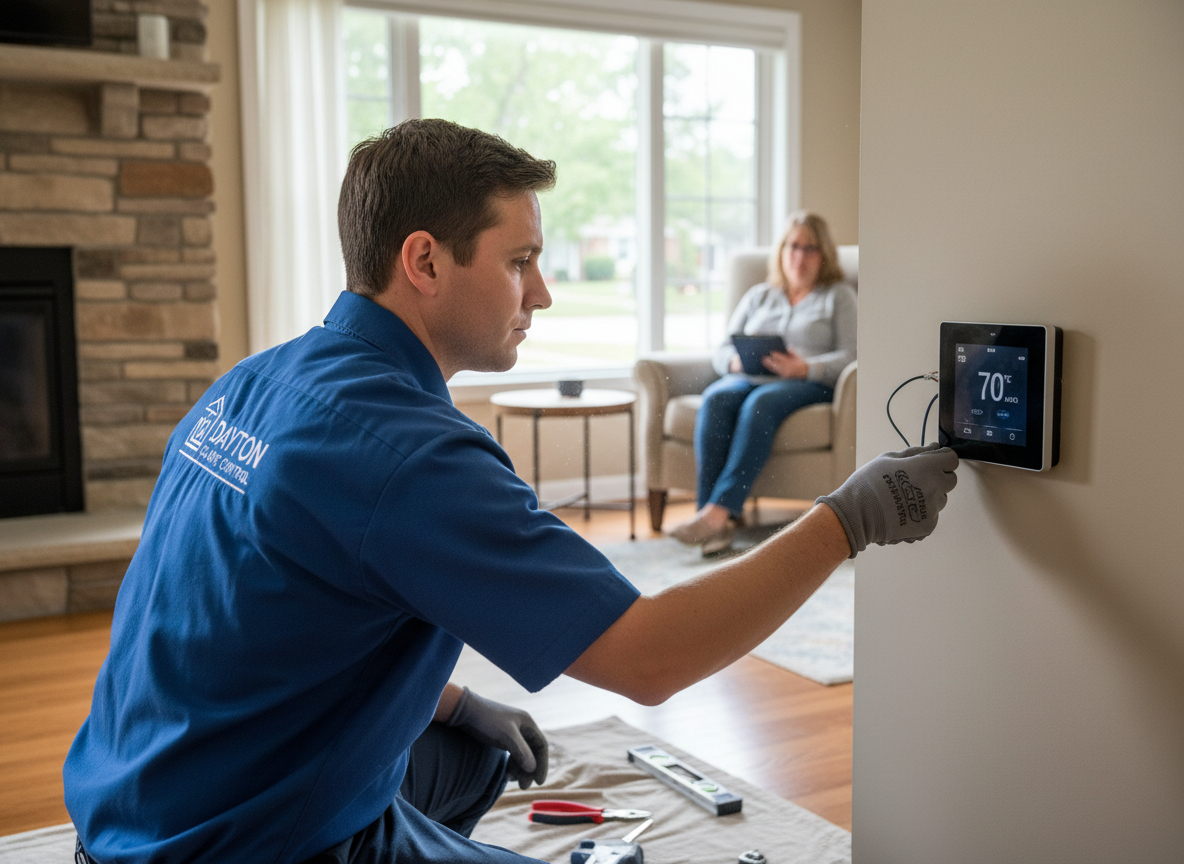
Dayton homes built before 1970 in neighborhoods like the Oregon District and South Park often have two-wire systems or knob-and-tube remnants that prevent direct smart thermostat swaps. We check voltage at the sub-base, verify C-wire presence or install a compatible adapter, and confirm the new unit integrates with existing forced-air or boiler setups common in Montgomery County. Hot summers push cooling loads hard while January lows demand precise heating staging, so we program schedules that avoid short-cycling and protect equipment from humidity swings.
Edge cases appear frequently around University Row rentals and South Park Victorians where landlords request separate tenant access without full system replacement. We install models that support remote sensors for multi-story layouts and confirm compatibility with the home's existing 24-volt transformer capacity. Code requires proper labeling of all low-voltage wiring and a final inspection tag when permits are pulled; we document every step so homeowners in Kettering or Beavercreek can show compliance during resale.
Battery backup models are recommended for areas prone to brief outages, and we always test Wi-Fi signal strength from the thermostat location before leaving. Poor signal in brick homes near Carillon Historical Park often requires a mesh extender rather than a full rewire. We also review filter-change reminders and humidity control settings to match Dayton's humid continental pattern and reduce mold risk in basements common throughout the county.
Technician insight
In Dayton, the thing that catches most people out with Smart Thermostat Installation is the number of 1920s–1950s homes in the Oregon District and South Park that still run on two-wire systems; without checking transformer capacity first you can blow the board on the furnace during the first cold snap.
South Park Two-Wire Retrofit
Homeowner in a 1948 South Park bungalow called after their new smart thermostat kept losing power. We found only two wires at the sub-base and a marginal 24-volt transformer. Added a common-wire adapter, relocated the unit for better Wi-Fi reach, and set humidity-aware schedules. System now holds temperature through both summer peaks and January lows without short cycles.
How it works
- 1
Site Assessment
Technician inspects existing wiring, transformer rating, and HVAC equipment at the Dayton address to identify compatibility issues before any work begins.
- 2
Wiring Preparation
We add a C-wire adapter or pull new low-voltage cable when needed, especially in pre-1970 homes in the Oregon District and South Park.
- 3
Unit Mounting and Connection
New thermostat base is installed, wires terminated, and the unit powered on to confirm communication with the furnace or air handler.
- 4
Configuration and Testing
Wi-Fi setup, schedule programming, and remote sensor pairing are completed, followed by a full system test through heating and cooling cycles.
Pricing
Upfront quotes after on-site wiring inspection; price varies with adapter needs and home age.