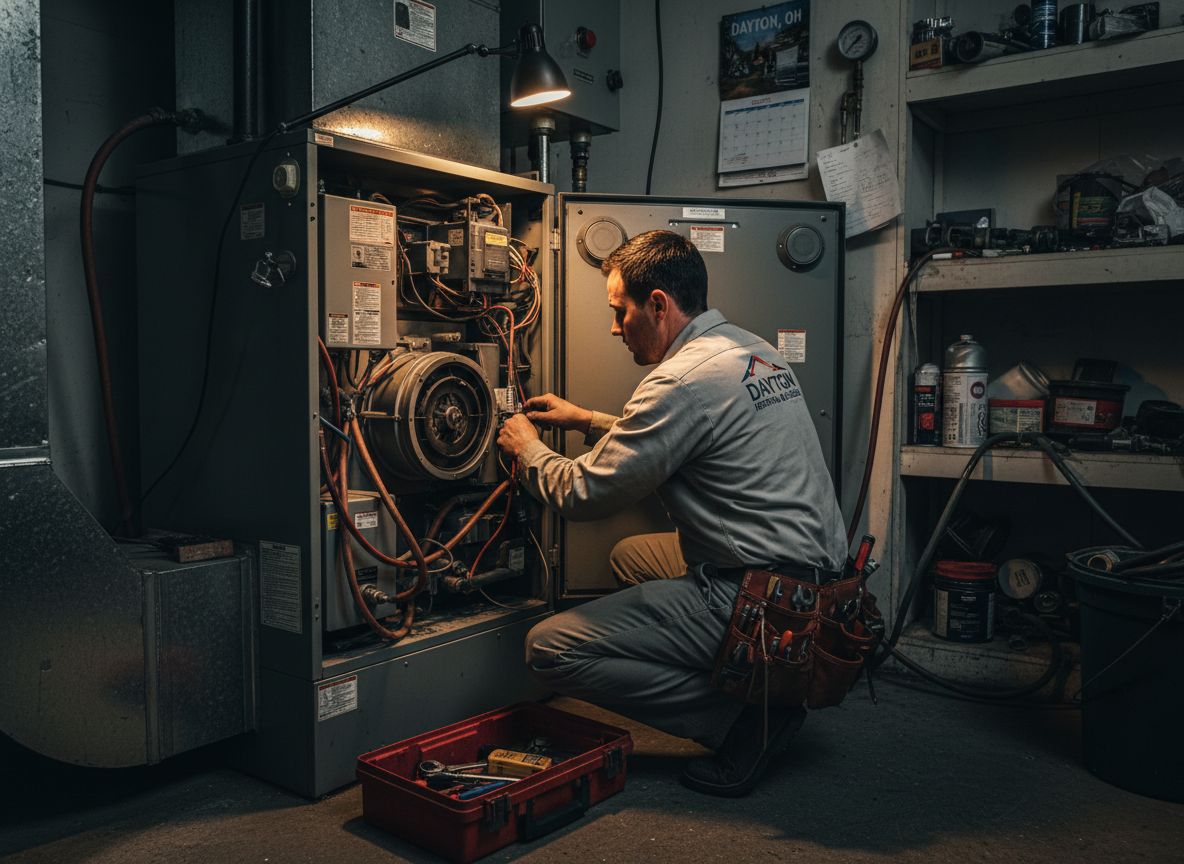
Dayton’s humid continental climate brings sharp winter temperature drops that push furnaces in Montgomery County neighborhoods like South Park and the Oregon District to run continuously. Many homes there date to the early 1900s and still use original ductwork or gravity systems that restrict airflow and accelerate wear on blowers and heat exchangers. Technicians must often adapt modern replacement parts to mismatched venting or undersized returns common in these brick and frame houses. Skipping a combustion analysis during repair can leave carbon monoxide risks undetected, especially when cold air infiltration increases negative pressure in older basements.
In Kettering and Beavercreek subdivisions built after World War II, forced-air furnaces frequently develop cracked heat exchangers from decades of thermal cycling during long cold snaps. Soil conditions around the Great Miami River valley add humidity that corrodes condensate drains and secondary heat exchangers faster than in drier regions. Repair calls here routinely involve checking for restricted intake pipes clogged by leaves or ice, and verifying that high-efficiency units maintain proper condensate neutralization to avoid drain line failures. Ignoring these local moisture patterns leads to repeated no-heat calls within weeks of the first service visit.
When a furnace fails during a January cold front, the priority is confirming safe operation before restoring heat. This includes testing limit switches, inspecting flue pipes for proper slope in homes with low ceilings, and ensuring blower motors can handle the static pressure created by older, undersized duct runs found throughout Downtown Dayton. Homeowners in University Row often discover that attic insulation upgrades have changed load calculations, requiring damper adjustments that were never addressed after the initial install. These details separate a quick fix from a repair that holds through the rest of the season.
Winter Load Patterns in Historic Dayton Homes
Older properties in the Oregon District and South Park experience higher static pressure from narrow chases and multiple elbows, so technicians always measure total external static pressure before closing a furnace repair. This step reveals whether the existing blower can support the repaired system or if motor speed taps must be changed to prevent short cycling during prolonged sub-freezing periods.
Technician insight
In Dayton, the thing that catches most people out with Furnace Repair is the original ductwork in South Park and Oregon District homes. Those 1920s runs create static pressure that modern replacement blowers were never sized for, so a simple part swap often turns into a full airflow rebalance once winter temperatures drop and the system runs nonstop.
No-Heat Call in South Park
Problem: Furnace would not ignite during a prolonged cold spell. What we found: Restricted return air from settled insulation blocking the original floor grates plus a failing igniter. What we did: Cleared the returns, replaced the igniter, and adjusted blower speed to match the existing duct static pressure. Outcome: Heat restored and system cycled properly through the remaining winter weeks.
How it works
- 1
Safety and Initial Assessment
Arrive on site, shut down power and gas, and perform a combustion and carbon monoxide check before any disassembly.
- 2
Component Diagnosis
Test limit switches, igniter, gas valve, and heat exchanger integrity using manufacturer-approved procedures for the specific model.
- 3
Repair Execution
Replace or rebuild failed parts while adapting to existing ductwork and venting conditions typical in Dayton’s older housing stock.
- 4
System Verification
Restore power and gas, run the furnace through multiple cycles, and confirm safe operation under current outdoor temperatures.
Pricing
Upfront quote provided after on-site inspection; final cost depends on parts required and system access in older homes.