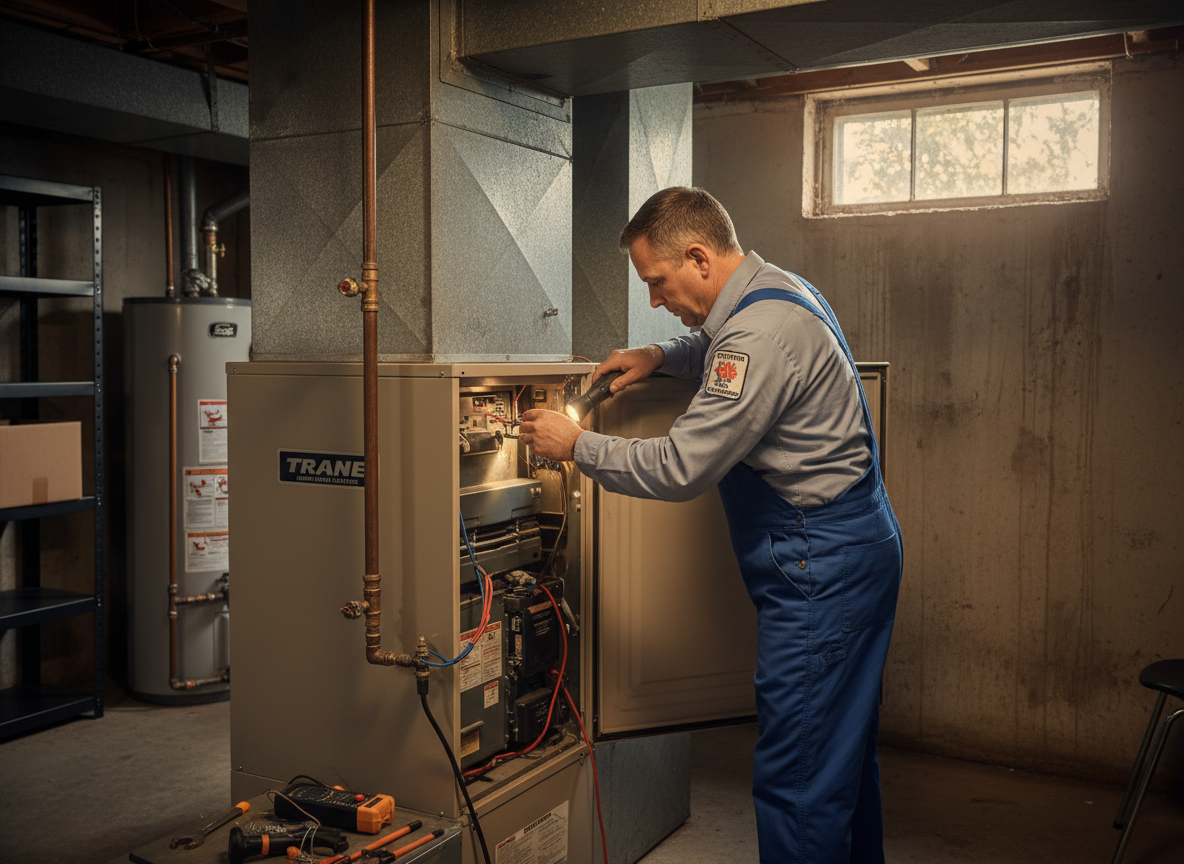
Dayton winters drop hard enough that a failing furnace quickly turns a home in the Oregon District or South Park into an icebox. Older housing stock from the early 1900s often has gravity furnaces or early forced-air systems with original duct runs that have settled and separated at the joints. We see cracked heat exchangers on units that have run through decades of Montgomery County freeze-thaw cycles, and the first sign is usually uneven heat or a faint metallic smell when the blower starts.
Kettering and Beavercreek split-levels built in the 1960s and 1970s commonly have the furnace tucked in a low closet with poor combustion air, so carbon monoxide risks rise when the cold snap hits and homeowners block vents trying to keep the house warmer. Our calls spike once temperatures stay below freezing for more than two nights because limit switches and draft inducers fail from constant cycling. We carry common inducer motors and pressure switches for these exact models so repairs finish the same day instead of waiting on overnight parts.
University Row apartments and converted homes near the Dayton Art Institute frequently have shared flues or undersized returns that starve the system. When we open the blower compartment we often find decades of construction dust mixed with insulation fibers that have been pulled through the filter and packed against the exchanger. Cleaning that alone can restore airflow without replacing the motor, but only if the technician checks static pressure instead of guessing at the problem.
We always test combustion and measure temperature rise across the exchanger before leaving. In Dayton’s humid winters that extra step prevents the short cycling that ruins new parts within a season.
Technician insight
In Dayton, the thing that catches most people out with Heating Repair is the original ductwork in South Park and Oregon District homes. Those runs were never sealed and the cold air infiltration through the joints makes the furnace short-cycle long before the heat exchanger actually fails. We have to seal and balance the ducts first or the new part lasts one winter.
South Park Furnace Short Cycling
A 1928 South Park two-story lost heat on a 12-degree night. We found the limit switch tripping from low airflow caused by settled and separated duct joints in the basement. After sealing the main trunk and replacing the switch the furnace maintained proper temperature rise and ran through the rest of the cold snap without issues.
How it works
- 1
Initial Safety Check
We test for carbon monoxide and confirm the system is safe to operate before any further work.
- 2
Full System Diagnosis
Technicians inspect the heat exchanger, blower, controls, and duct connections while the system runs.
- 3
Targeted Repair
We replace or rebuild only the failed components using parts matched to the existing equipment.
- 4
Performance Verification
After repair we measure temperature rise, combustion, and airflow to confirm the system meets original specifications.
Pricing
Upfront quote after diagnostic inspection; no hidden trip charges during business hours.