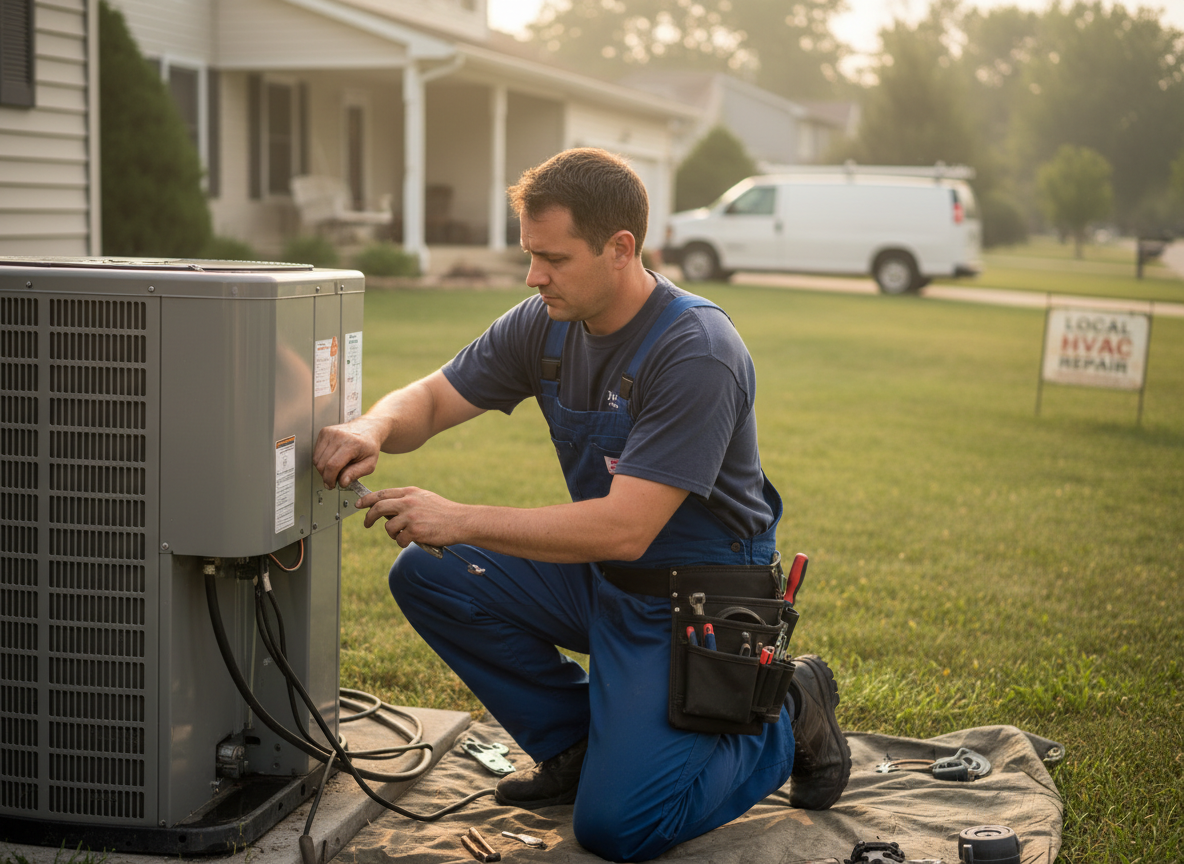
In Dayton’s older housing stock found in the Oregon District and South Park, many systems still rely on original ductwork and single-stage equipment that struggles once winter temperatures drop below freezing. Technicians regularly see condensate lines freeze in unconditioned basements and attic units that were never properly sized for the area’s humidity swings. Proper diagnosis requires checking static pressure across the entire duct run rather than just swapping a capacitor, because restricted returns in these tight, century-old homes quickly lead to coil icing and compressor failure.
Summer calls in University Row and near the Dayton Art Institute often trace back to capacitors that failed during prolonged 90-plus-degree stretches combined with high dew points. When replacing contactors or motors, crews verify that the new components match the original FLA ratings listed on the unit data plate, since many homes still have 1980s and 1990s equipment that was never upgraded after the last refrigerant changeover. Skipping this step can trip breakers or shorten the life of the new part within a single season.
Homeowners in Kettering and Beavercreek frequently discover that their heat pumps were installed without proper auxiliary heat kits sized for the county’s design temperature. During a no-heat call, the first step is confirming whether the outdoor unit is actually running or locked out on a pressure switch caused by ice buildup from earlier mild days followed by a sudden drop. Addressing the root sensor or defrost board issue prevents repeated emergency visits once true winter arrives.
Technician insight
In Dayton, the thing that catches most people out with Local HVAC Repair is the combination of older single-stage equipment and the rapid temperature swings between our humid summers and single-digit winter nights. Homeowners in South Park and the Oregon District often replace a run capacitor only to have the compressor fail two weeks later because the underlying airflow restriction from original ductwork was never addressed.
No Heat on a January Morning in South Park
A homeowner in a 1920s South Park house reported the furnace running continuously without producing warm air. Inspection found the limit switch tripped from restricted return airflow through the original floor registers. Technicians cleaned the returns, replaced the switch, and verified the blower motor was not overheating. Heat was restored the same afternoon and the system has run without further limit trips.
How it works
- 1
Initial Assessment
Arrive on site and document current system performance, thermostat settings, and any recent changes in comfort.
- 2
Diagnostic Testing
Measure voltage, amperage, refrigerant pressures, and airflow to isolate the exact failure point.
- 3
Repair Or Replacement
Replace failed components with matched parts and restore proper operation before leaving.
- 4
System Verification
Run the unit through a full cycle and confirm temperature split and safety controls function correctly.
Pricing
Upfront quotes are provided before any repair work begins.